
Real-World Wins from Having a Strong Company Culture with a focus on the customer
In 2025, many a CEO claims that culture is their secret weapon — but few can actually prove it. And fewer still have a dedicated, lasting focus on the company culture.
The truth? A strong organizational culture isn’t a “soft” concept. It’s a measurable driver of profitability, innovation, and customer loyalty.
Let’s explore how iconic organizations —Southwest Airlines or Cleveland Clinic and Swisscom, vastly different in their products and services — turned culture into competitive advantage, and what your company can learn from them.
What Is Organizational Culture (Really)?
Your organizational culture is the invisible operating system behind every decision, meeting, and customer interaction. It is the glue of the company, tying customers, owners and team-members together. It defines de how, not the what.
According to organizational culture theory, companies with aligned values and behaviors outperform their competitors on engagement, productivity, and innovation. (read Edgar Schein and especially Geert Hofstede)
When culture and strategy work together, teams stop asking “Can we do this?” and start saying “How do we make it happen?”
A key element of culture must also be the question about “how does it make the stakeholder feel”
Southwest Airlines — The ROI of Employee Happiness
If you’ve ever flown Southwest Airlines, you’ve experienced their culture firsthand: laughter on board, friendly service, and genuine smiles.
That’s not luck. It’s design. It is a dedicated and lasting effort by the Top level. It is part of the DNA of Southwest.
Southwest has built its success on a simple principle: “Take care of your people, and they’ll take care of your customers.” Please note that essential principle explicitly mentions the customer. Ritz Carlton says similar with their motto “Ladies and Gentlemen serving Ladies and Gentlemen”. Note also that this came from the co-founder of the brand, Mr Horst Schulze.
By prioritizing employees before customers, they’ve maintained profitability in an industry notorious for turbulence — both literal and financial.
And this different focus and the positive results it brings (bottom line) is a key differentiating factor.
Takeaway: A great customer experience always begins with a great employee experience.
Cleveland Clinic — Empathy as a Cultural Strategy
When Cleveland Clinic set out to redefine healthcare, it didn’t start with technology or facilities. It started with empathy.
Every employee — from surgeons to receptionists — received empathy training to help them see patients as customers, not medical cases.
A driving principle for Cleveland Clinic is to consider hospitals more as hotels that provide medical services.
In Switzerland Clinique de Genoliers, a leading private hospital, actually offers clients choice of menus, choice of wines. Compare that to many hospitals that seem to want to ban alcohol altogether, even in maternity wards, the difference in approach is huge.
Note that when entering a hospital, you hand over the totality of your life to medical staff. The only choices that are left, in limited cases, is for the patient to choose bland meal n° or bland meal n°2. We all know that creating happiness is a contributing element to recovery and comfort food as well as joy are important elements in this recovery.
The result for Cleveland Clinic?
Patient satisfaction scores soared.
Complaint rates dropped.
The Clinic became a global benchmark for compassionate healthcare.
That’s culture change in action — not words on a wall, but behaviour in motion.
Takeaway: Emotional intelligence isn’t soft. It’s strategic. And the impact can be measured.
Swisscom — Inclusion as a Catalyst for Innovation
Swisscom, Switzerland’s leading telecom provider, discovered that an inclusive culture drives measurable performance.
They ran recurring culture surveys and analyzed how inclusion affected innovation and engagement. The findings were clear:
Teams that felt included generated 50% more new ideas
Employee engagement rose by 20%
Innovation cycles shortened
This is what inclusive culture meaning looks like in practice — not just diversity quotas, but systemic inclusion that fuels creativity.
Swisscom was known years ago as a monopolistic provider with an attitude that hadn’t changed when the market opened up : bad service, high cost, no empathy with the customer.
When, in training sessions, we asked people in 2023 and onwards to mention a company they thought delivered on service excellence, many cites Swisscom as a positive example.
Takeaway: Inclusion isn’t a CSR checkbox. It’s a growth engine, delivering tangible results and ensuring lasting growth.
Measuring What Matters — From Surveys to Strategy
Culture can’t be managed if it isn’t measured.
Start with a culture survey that tracks alignment with your company values.
Do employees understand our purpose?
Do they feel safe sharing ideas?
Do leaders model our values?
And more
Use both data and stories. The best organizations pair survey results with qualitative insights — employee interviews, focus groups, and leadership reflections.
When you can measure your culture, you can improve it.
Takeaway: You can’t improve what you don’t track. Culture deserves KPIs, too.
The Real-World ROI of Culture
Companies that intentionally invest in culture outperform those that don’t: (Harvard business School study, 2025)
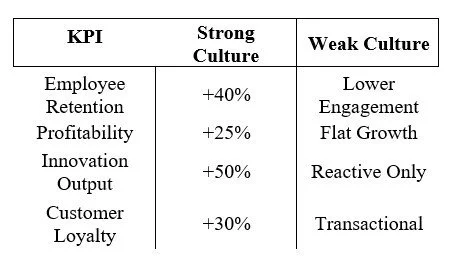
HBS 2025
A thriving culture doesn’t just make people happier — it makes businesses healthier.
Takeaway: Culture is the multiplier of every other investment.
The Leadership Imperative
Leaders are the guardians of culture.
They shape it by what they reward, tolerate, and model.
Whether it’s Southwest’s servant leadership, Cleveland Clinic’s empathy-first training, or Swisscom’s inclusive decision-making, each example shows that sustainable culture starts at the top.
Culture doesn’t survive PowerPoint slides — it lives through people.
Takeaway: Leaders don’t just communicate culture; they embody it.
What next ? How to embed culture into Your Company DNA
If you want to make culture your competitive edge in 2025, start small but start today:
Define your core values clearly — and communicate them constantly.
Measure your current culture using data (culture surveys, feedback loops).
Align leadership behaviour with your desired culture.
Reinforce daily wins — culture grows from repetition, not campaigns.
Takeaway: Culture is what your people do when no one is watching.
Final Thoughts
The companies thriving in 2025 don’t just have strategies. They have shared beliefs and they do what they say.
Culture isn’t a project — it’s a living ecosystem that drives performance, inclusion, and innovation.
If you’re serious about turning culture into a growth engine, start by asking questions like:
“What’s it like to work here — and does that help or hurt our strategy?” or “how do people feel about our products, our services, our ways of doing things?”
These answers hold the key to your company’s next real-world win.
Over to You
How does your organization measure and sustain culture? Have you seen examples where culture directly improved business performance?
Explore how we help organizations like yours design thriving, inclusive cultures with a guest or customer focus at orizonadvise.com.
https://www.youtube.com/watch?v=OQQM4U8wE8A
#OrganizationalCulture #CultureChange #InclusiveCulture #Leadership #EmployeeEngagement #CustomerExperience #BusinessTransformation #OrizonAdvise