
Unlocking Hidden Value: Why Operational Hotel Asset Management is the New Executive Mandate
Article 1 of 5 in the Series: Reimagining Hotel Asset Management by Pierre Verbeke for Orizon Advise
I. The Crossroads of Hospitality Investment: Passive vs. Proactive
For decades, the standard playbook for hotel ownership revolved around capital deployment, brand selection, and monitoring financial reports. Asset management often equated to a high-level, passive oversight role—the "check-up" at the end of the quarter. In today’s hyper-competitive and rapidly evolving hospitality landscape, this model is not enough; it’s a threat to realizing an asset’s full potential.
The global environment—marked by fluctuating labour costs, expanding guest expectations, and rapid technological advancement—has created a divergence. Assets managed passively are seeing performance plateau, while those managed proactively are setting new benchmarks for profitability. This stark reality demands a fundamental shift in approach, leading directly to the new executive consulting mandate: Operational Hotel Asset Management.
This is not just a deeper dive into the Profit & Loss (P&L); it’s a transformational philosophy. It views the asset through the lens of a highly engaged operator, ensuring that every operational decision—from purchasing contracts to employee engagement strategies—is directly aligned with the owner's long-term financial goals and exit strategy. The question is no longer if asset managers should be operational, but how quickly ownership can implement this strategic shift. The profile needed for this new approach differs vastly from previous profiles : operational experience has become a must.
II. The Failure of Financial-Only Oversight
When asset management is confined to financial reporting, it creates critical performance gaps that only executive consulting can effectively bridge. The operational asset manager in fact becomes a virtual member of the hotel operational structure. An outside view provides an unbiased or untainted perspective.
A. The Organizational Culture Disconnect
In the traditional model, the owner’s financial objectives (e.g., maximizing cash flow for sale) often exist in a vacuum, disconnected from the property's organizational culture. Property General Managers (GMs) are focused on the immediate operational needs, leading to a breakdown in strategic alignment.
The outcome is an organizational structure where teams are tempted optimize their own silos, sacrificing enterprise value. The Revenue Manager maximizes ADR detached from the cost factor, and the Operations team maximizes service not always with financial efficiency in mind. There is less unified, shared culture of "asset stewardship."
B. Reactive vs. Proactive Value Creation
Passive asset managers react to variance reports, whereas operational managers proactively create performance, they do not merely explain, they look at solutions for the future.
The move from passive review to proactive intervention requires a specific level of expertise and authority—the hallmark of executive consulting.
Looking at numbers only for explanation doesn’t cut it. It needs operational understanding to be forward looking and think together with the operational team about the way forward.
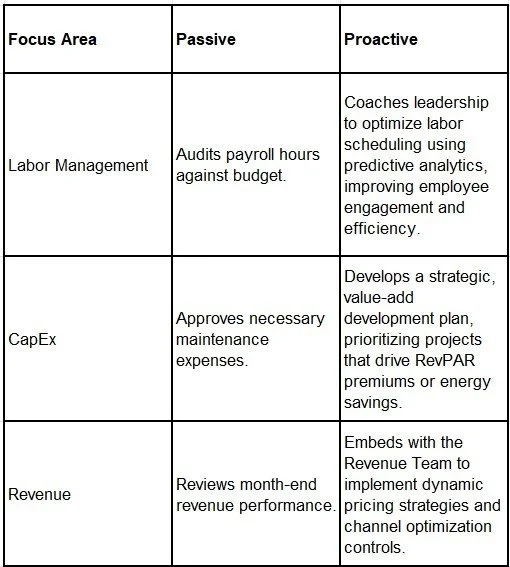
III. Essentials of Operational Asset Management
The transformational blueprint for OHAM rests upon three interconnected pillars, each requiring specialized executive consulting to implement successfully:
1: Strategic Alignment and Culture
This involves recalibrating the hotel’s fundamental purpose to align with the owner’s mandate. It is about creating a high-performance culture where every employee understands their impact on asset value. This is the bedrock of sustainable performance, transforming the organization from a cost centre into a value creator. Asset value is one thing, operational optimisation for the future is another and owners’ reputation is another still. These need to be aligned, looking forward.
2: Operational Excellence and Efficiency
This is the technical core: the identification and elimination of waste and inefficiency across all departments. This requires deep operational knowledge to optimize expense lines (labour, utilities, procurement) while simultaneously enhancing the guest experience to protect RevPAR. True operational excellence drives immediate GOP growth and is a clear signal of an asset ripe for future development. Customer satisfaction and employee engagement must be integrated into the drive for excellence and efficiency.
3: Leadership Development and Accountability
The operational transition is only sustainable if the property leadership is equipped to carry it forward. This requires implementing rigorous coaching and development programs for GMs and department heads, transforming them into asset stewards with a financial mindset. Without this investment in leadership, any gains achieved will be temporary. To become more durable, gains must not be just monetary, quality of service and customer satisfaction are equally important, this cannot be underrated.
IV. Embedding the Executive Consultant: The Catalyst for Change
An external executive consulting firm is the ideal catalyst for initiating this transformational shift for several reasons:
Unbiased Authority: Consultants possess the neutrality needed to challenge long-standing, inefficient practices without the internal political friction an operator faces.
Specialized Development: They bring best-in-class frameworks, sophisticated technology knowledge, and deep expertise in organizational restructuring and leadership development honed across multiple assets and cycles.
Speed and Focus: They are brought in to execute a focused, short-term transformational project (the blueprint), driving results far faster than an internal team grappling with competing priorities.
The consultant’s role is not just to advise, but to temporarily embed and co-manage the necessary changes, ensuring that the new operational mindset becomes the new organizational culture. They are the engine driving the initial burst of performance development.
V. The New Executive Mandate: Transforming the Team
The affirmed goal of operational asset management is not merely to optimize the P&L; it is to maximize the final asset valuation. A hotel that demonstrates a high-performing, transferable, and efficient operational platform is significantly more attractive to investors. Many operators stop at the GOP, leaving the rest to the owners. This is so by contract.
An asset manager must, together with the operational team, look at the total picture, owners’ objectives included.
Transformational success is achieved when the property team:
Moves from compliance-focused leadership to strategic, value-focused leadership.
Sees employee engagement and customer satisfaction metrics as critical financial indicators.
Views every decision, from staffing to technology upgrades, as part of a structured development plan designed to increase the asset's market worth.
Look beyond the annual budget
This shift in perspective is the essence of the new operational asset management mandate in hospitality. It is the necessary evolution for any owner committed to true value creation.
Ready to Find the Hidden Value in Your Hotel Asset?
The journey from passive oversight to active operational value creation requires a clear, proven transformational blueprint. Our executive consulting team specializes in aligning your organizational structure and property leadership with your highest financial goals.
Start the transformation. Contact us today.
Request a Preliminary Asset Performance Review
This article is the first in a 5-part series by Orizon Advise dedicated to defining the necessary transformational shift in hotel ownership strategy.
#ExecutiveConsulting #HotelAssetManagement #Transformational #Leadership #HospitalityInvestment