
The Transformational Blueprint : How strategic coaching and embedded leadership development create an organisational culture obsessed with creating value
Article 3 of 5 in the Series: Reimagining Hotel Asset Value
I. The Shifting Paradigm: From Oversight to Operational Value Creation
For many years hotel asset management has been viewed through a purely financial lens—a reactive exercise in quarterly reporting, budget auditing, and CapEx sign-offs. An important, if not sole focus, was on the financial value of the asset. This rather passive approach is no longer sustainable in a complex, volatile global market. The future of superior asset performance lies in a deep, proactive engagement with the hotel's daily operations.
The shift from traditional, hands-off asset management to an operational-first approach is no longer optional— it's the core differentiator for maximizing owner returns. As detailed in the foundational analysis of the advantages of operational asset management in hotels, the emphasis must fundamentally be on value creation at the ground level, not just monitoring the results of others at the end of a period. Our focus now is on the strategic 'how'—the transformational blueprint only executive consulting can provide. And secondary focus is on forward thinking – flow-through over just GOP or NOP.
Operational Hotel Asset Management (OHAM) is a transformational necessity. It means moving beyond scrutinizing the P&L to actively shaping the P&L through targeted interventions in revenue strategy, cost management, guest experience, and—most critically—people management. This level of engagement requires a unique blend of C-suite finance acumen and on-the-ground operational expertise, a blend rarely found within a typical owner-operator relationship. This is the moment the executive consulting imperative takes center stage.
Traditional hotel operators will want to retain the prerogatives of their management contracts but the short term objectives of most Operators (GOP based fee remuneration system or revenue based franchise fees) isn’t always in line with the longer term objectives of most owners. The reputational objective of some owners also come into play, especially in some markets where the cultural approach to asset ownership may differ from the European or US approach.
II. The Consulting Imperative: Beyond the Balance Sheet
Why is external executive consulting essential for this transformation? Because the true challenges in underperforming assets are systemic and generally embedded in the existing organizational culture and leadership structure. An internal team, or a traditional asset manager focused solely on financial reporting, lacks the necessary distance and authority to challenge the status quo. As stated in article one, the profile of traditional asset managers is generally from a business school background, from finance experience mainly. We also see most of the large consulting firms, that certify the accounts of companies, offer asset management services with consultants that have little or no operational knowledge of hotels or hospitality assets,
Executive consultants don't just audit; they embed leadership structures, bridge the owner/operator gap, and instil a culture of shared accountability.
Objective Diagnosis: Consultants bring unbiased expertise to identify the root causes of underperformance—which are frequently operational (e.g., poor forecasting, inefficient labour scheduling, high employee turnover) rather than just market-related.
Stakeholder Alignment: They serve as the critical bridge, translating the owner’s long-term value creation mandate into actionable, short-term operational goals for the General Manager and executive team.
Speed of Change: Transformation requires nimbleness. Consultants accelerate the process of change implementation, acting as temporary, highly experienced executives to stabilize performance while simultaneously building internal capabilities.
Their ultimate role is to introduce and operationalize a comprehensive transformational framework—a blueprint that permeates every layer of the asset’s management.
The fact that operational consultants understand the hospitality ecosystem makes their intervention much more palatable to the team.
III. Architecting an Organizational Culture of Performance
The most valuable, yet often overlooked, asset is the hotel’s team and organizational culture. A hotel with a strong, performance-oriented culture can weather economic storms and outperform competitors with identical physical assets.
In OHAM, executive consulting focuses on 3 main areas :
A. Aligning Culture with Value
The owner’s mandate (e.g., maximize sale price in 5 years, Capex ROI, …) must be translated into the front-of-house employee’s daily objectives (e.g., maximize up-selling, reduce guest complaint time). This process requires defining the core values of "Asset Stewardship."
Consulting Action: Design and implement a cross-departmental "Value Creation Charter" that defines success not just as filling rooms, but as protecting and enhancing the asset’s long-term worth.
B. Driving Employee Engagement and Retention
High employee engagement is directly correlated with higher guest satisfaction and lower operating costs—the two most immediate drivers of Net Operating Income (NOI). Consultants help diagnose and rectify friction points that lead to costly turnover.
Consulting Action: Implement focused pulse surveys and managerial coaching on engagement best practices. The goal is to move beyond superficial incentives and embed a culture of recognition and purpose. Lowering key department turnover by just 10% can save thousands in recruitment and training costs annually.
C. Operationalizing Communication
A fragmented organizational structure, where Sales, Revenue Management, and Operations exist in silos, kills efficiency. The blueprint demands a cohesive communication strategy where departmental goals are interdependent.
Consulting Action: Introduce daily/weekly "Performance Huddles" and standardized reporting dashboards that force cross-functional teams to discuss key metrics impacting the NOI.
IV. The Transformational Leadership Journey
Operational success is impossible without transformational leadership at the property level. The General Manager and their executive committee must evolve from simple operators to strategic asset stewards. The consultant’s role shifts here to one of deep coaching and development. The focus of this coaching must be about creating a mindset where the Team is acting together, understands the objectives of the asset owner and asset operator and align their professional goals with the goals of the owner / operator.
Let’s consider the following :
Defining Transformational Leadership in Hospitality
Transformational leadership in this context means leaders who:
Inspire: They articulate a clear vision that connects the daily tasks of the team to the larger owner value creation goal.
Challenge: They encourage continuous improvement and question long-held inefficient practices.
Empower: They grant autonomy to managers and employees, fostering ownership and engagement.
Forward looking : convince the team to view towards the future, understanding impact of actions at any specific time in the present and their implication in the future on owners’ return, on profit margins and on their own remuneration
The Power of Executive Coaching
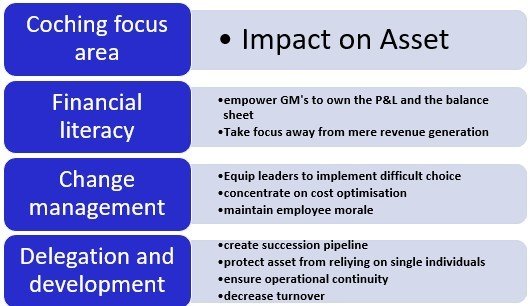
The most impactful element of the executive consulting blueprint is individualized coaching. This is not generic training; it is targeted support for the leadership team on applying the new operational mandate.
Orizon Advise
This continuous development ensures the transformational changes are internalized and sustained long after the consultant departs.
V. The Blueprint in Action: From Strategy to Sustainable Execution
The final stage of the transformational blueprint is the strategic implementation and institutionalization of new operating procedures. Executive consulting ensures that the strategy is embedded, not just delivered. Executive consulting drives the change from reactive to proactive.
A. Process Harmonization and Standardization
This addresses the "messy middle" of operations—the procedures that eat into profitability. Examples include: streamlining the procurement process, implementing utility reduction protocols, and optimizing the labour matrix to match true demand.
Consulting Action: Develop and standardize a "Zero-Based Review" process for all major expense lines. Organizational changes require documented, easy-to-follow procedures.
B. Strategic CapEx Planning
The best OHAM consultants ensure CapEx is a value-add, not just a necessary expense. Every major investment must align with the owner’s ultimate (exit) strategy.
Consulting Action: Conduct a holistic development assessment, prioritizing investments that directly impact guest ratings, energy efficiency, or market positioning for the intended buyer profile.
C. Instituting Accountability through Data
The transformation is sustained by metrics. The leadership team must move from reporting what happened to explaining why it happened and what will change next.
Consulting Action: Establish a transparent, shared dashboard of 3-5 Key Operating Metrics (KIMs) that track operational performance, employee engagement, and guest satisfaction, linking them directly to the GOP.
Action : establish a gratification system based on more than just achieving end-month targets : forecast accuracy, cost prediction, flow-through, transformation of fixed costs into variable costs (even at a premium).
The consultant’s role here is to facilitate the long-term development of internal capabilities. By building the muscle for continuous improvement, the asset gains resilience and competitive advantage. The true ROI of executive consulting is the creation of a self-sustaining, high-performance organizational culture.
VI. Conclusion: The ROI of Transformation
The cost of inaction—the opportunity cost of sustained underperformance, high turnover, and missed revenue opportunities—far outweighs the investment in specialized executive consulting.
The transformational blueprint delivered by an operational consultant yields tangible returns:
Accelerated GOPAR Growth: Through optimized revenue management, labor controls, and expense discipline.
Increased Asset Valuation: By demonstrating a robust, sustainable, and transferable operational model to potential buyers.
A Resilient Leadership Team: Capable of steering the asset through any market cycle, reducing owner intervention.
Owners’ trust : critical for a long lasting relationship with the operator.
This is the strategic difference between merely owning a hotel and owning a high-performing asset. It’s the difference that transformational leadership and a performance-driven organizational culture make possible. For the forward-thinking owner, operational excellence is the final, untapped frontier of value creation.
Your Asset’s Transformation Begins Now.
The shift to operational asset management requires more than just a new mindset—it demands a proven transformational blueprint. Seize the opportunity. Our executive consultants specialize in embedding the leadership structures and organizational culture necessary for sustainable GOPAR growth and maximizing your asset's eventual sale value.
Ready to unlock the full potential of your hotel assets?
Schedule a Confidential Transformation Strategy Session
This article is part of a 5-part series by Orizon Advise on Reimagining Hotel Asset Value, focusing on the intersection of executive consulting, transformational change, and operational performance.